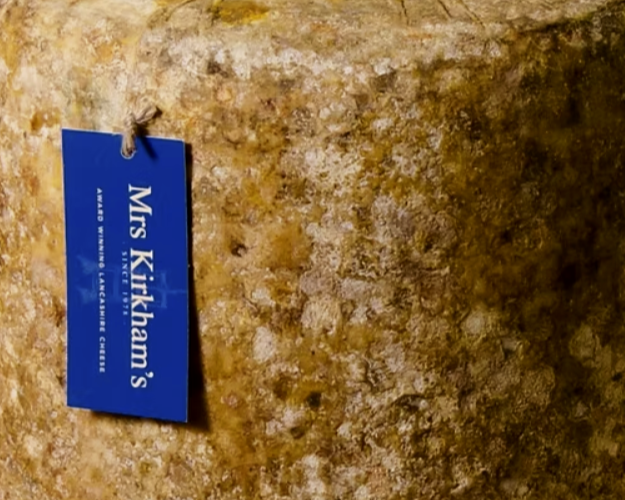
Mrs Kirkham’s: Raw Milk Lancashire Maker
“Mrs Kirkham’s is a truly authentic farmhouse Lancashire cheese - made with raw milk. While the industrial creameries of the 20th century wiped out the traditional method, the Kirkham family held the line at Beesley Farm, protecting a buttery crumble texture that has become a legend of British cheese.”
1. The Heritage
The story began in 1978 when Ruth Kirkham, armed with a recipe from her mother Ruth Townley, started making cheese in the old piggery at Beesley Farm. At that time, she was just one of many, but as strict regulations and industrialisation swept through the dairy industry, every other raw-milk Lancashire producer closed their doors or switched to pasteurisation.
Today, the dairy is run by her son, Graham Kirkham, who has become a celebrated figure in the artisan food world. He continues to make the cheese exactly as his mother did, serving as the guardian of a tradition that dates back to the 13th century.
2. The Location
The cheese is made exclusively at Beesley Farm in the village of Goosnargh, near Preston. This area is known as the "Lancashire Milk Fields," a region of lush, low-lying pastures that produce exceptionally rich milk. Unlike factory cheeses that tanker in milk from all over the country, Graham uses raw milk from his own closed herd of 100 Holstein Friesian cows that graze the fields directly surrounding the dairy. This "farm-to-form" proximity is crucial, as the milk is used fresh every single morning while it still retains its natural warmth.
3. The Difference
The "Two-Day" Curd: This is the secret to real Lancashire cheese. Unlike Cheddar (made in a single day), Mrs Kirkham’s is made by blending curds from today’s milking with curds from yesterday’s milking. This unique mix creates a complex acidity and the famous "buttery crumble" texture that industrial versions cannot replicate.
Raw Milk: It is the considered to be the only Lancashire cheese in the world still made with unpasteurised milk. This preserves the natural flora of the farm, giving the cheese a "terroir" that changes subtly with the seasons - tasting of fresh grass in spring and rich hay in winter.
Butter Sealed: In a method almost lost to history, the cheese is cloth-bound and then "buttered up" (sealed with melted butter) rather than waxed or vacuum packed. This allows the cheese to breathe and develop a natural rind during its maturation.
Slow Maturation: While factory Lancashire is generally rushed out in weeks, Graham matures his wheels for months (up to 6 months for the 'Tasty' variety), developing a savoury, broth-like depth.
4. The Hero Products
Creamy Lancashire: The classic. Aged for 2–3 months, it is fluffy, yoghurty and clean-tasting. This is the ultimate "melting cheese" and the traditional partner to a Lancashire hotpot or Eccles cake.
Tasty Lancashire: The same cheese but aged for over 4 months. The texture becomes firmer and the flavour deepens into something savoury and oniony. It is the connoisseur’s choice.
Smoked Lancashire: A newer addition, smoked naturally over oak chips. Unlike artificial smoke flavorings, this has a delicate, campfire aroma that doesn't overpower the milk.
5. The Essentials
Accreditations: Specialist Cheesemakers Association; Slow Food Ark of Taste.
Product Index: Raw Milk Cheese, Farmhouse Lancashire, Smoked Cheese.